
Event summary: Accelerating universal health coverage for a more resilient world
25th September 2026
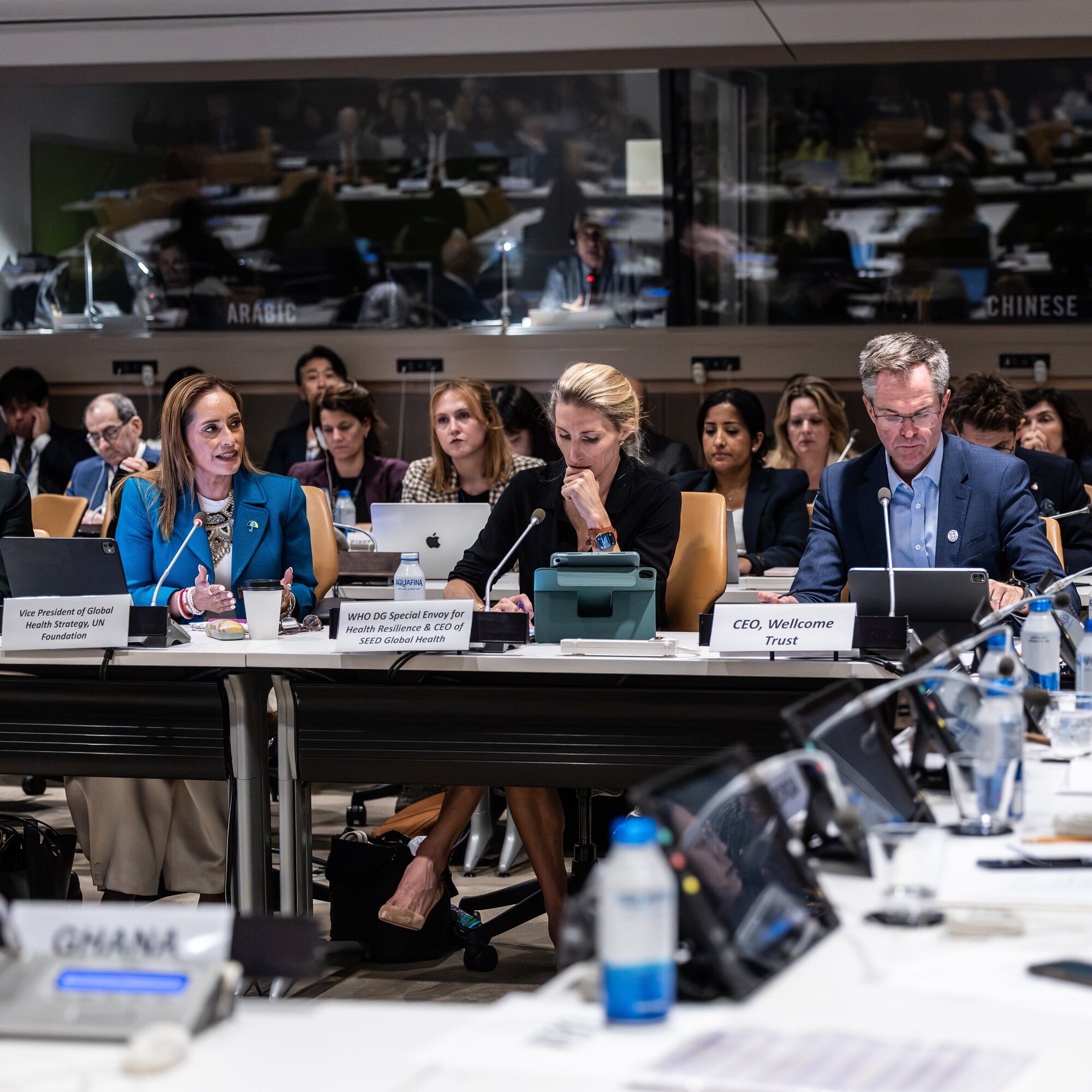
On the margins of the 81st session of the UN General Assembly, the Group of Friends of Universal Health Coverage and Global Health convened its seventh annual ministerial meeting, informally launching preparations for the 2027 High-Level Meeting on UHC.
During the event, participants took stock of progress and remaining gaps in the accessibility and affordability of health services since the 2023 Political Declaration, and considered how the 2027 meeting and its declaration can advance the policies, systems and investments needed to accelerate action on health for all in the final years of the SDG period, while anchoring UHC in a global health landscape undergoing profound change.
Throughout the discussion, a consensus emerged that the 2027 High-Level Meeting should not be where UHC is redefined, but where it gets delivered. Participants called for sustained political will and investment in the foundations that deliver UHC: a skilled health workforce, integrated primary care, and robust community engagement supported by the surveillance and information systems that show where coverage gaps remain. Country-led action, backed by a more coherent global health governance and financing architecture, was framed as essential to improve access, affordability and quality of care in widely differing geographies, fiscal circumstances and political contexts. As the Minister of Health of Armenia, H.E. Anahit Avanesyan, stated: "Global frameworks and political declarations provide the map, but the domestic execution builds the road." Looking ahead to 2027, participants agreed that UHC must remain an urgent health and development priority, anchored in national and global agendas now, post-2030, and beyond.
Cross-Cutting Messages
The 2027 High-Level Meeting arrives at a pivotal moment: despite hard-won gains, the world remains off track to achieve UHC by 2030. Dr. Bruce Aylward of WHO reminded that at least 4.6 billion people lack access to essential health services, and more than 2 billion face financial hardship from out-of-pocket health spending. Participants expressed deep concern that progress is at risk of further backsliding amid insufficient and unsteady political will and investment, particularly against receding development assistance and rising debt burdens. Dr. Magda Robalo of UHC2030 further stressed that these impacts risk widening inequalities and falling hardest on vulnerable populations, deepening barriers to access and pushing more people into poverty.
Achieving UHC and leaving no one behind requires sustained political and financial investment that can withstand geopolitical headwinds, fiscal pressures, and health system shocks. H.E. MOTEGI Toshimitsu, Minister of Foreign Affairs of Japan, underscored that domestic resource mobilization and smart spending remain the foundation for long-term health system resilience. At the same time, Norway stressed the need for a more coherent global health architecture that anchors UHC investments in country ownership: simplifying reporting, aligning external assistance with national plans, and building toward self-reliance, as set out in the Lusaka Agenda and the Accra Reset. Pushing back on the notion that UHC is "not selling" to policymakers and investors, Dr. John-Arne Røttingen of the Wellcome Trust emphasized that the UHC agenda encompasses a full slate of public health priorities, from maternal and child health to infectious diseases, NCDs, and mental health, all delivered through shared investments in the same underlying systems. Georgia’s Minister of Internally Displaced Persons from the Occupied Territories, Labour, Health and Social Affairs, H.E. Mikheil Sarjveladze, noted that sustained investment in core capacities, including workforce, surveillance systems, robust primary care and public finance management, improves overall health system performance and the quality of decisions behind it.
Investing in UHC builds more resilient health systems that provide day-to-day services while simultaneously preparing for crises. Dr. Vanessa Kerry of Seed Global Health and the WHO Special Envoy for Health Resilience emphasized that emergency preparedness, response, and recovery run through routine health systems: surveillance and labs that detect emerging pathogens also handle routine diagnosis; supply chains that deliver medicines can be redirected in a crisis; and the health workforce absorbs surge demand while protecting essential services. Yet, while UHC and health security are often described as two sides of the same coin, these core functions remain siloed in how many countries plan, budget and finance their health system – reflecting neither effective public health practice nor sound fiscal policy. Building on recent commitments to pandemic prevention, preparedness and response (PPPR), Dr. Ceclia Mundaca Shah of the UN Foundation pointed to the 2027 HLM on UHC as an opportunity to call for greater policy coherence in budget lines, legal mandates, and reporting structures that make gaps in core capacities visible, and therefore actionable.
Integrated, people-centered primary health care (PHC) is the key driver of UHC and the foundation for a more efficient and equitable health system. Several countries (Armenia, Georgia, Guyana, Hungary, Norway, Spain) described PHC as people's entry point to the health system and the engine for efficiently meeting a wide range of health needs, from prevention and early diagnosis to routine immunization and management of chronic conditions, closest to where people live. As multimorbidity increases and coverage for noncommunicable diseases (NCDs) lags furthest behind, Ms. Katie Dain of the NCD Alliance called for health systems to move beyond fragmented, disease-specific approaches toward integrated, people-centered service delivery. Hungary also identified complementary investments needed to expand access to quality primary health care, including a skilled, fairly paid and equitably distributed health workforce. H.E. Vijavat Isarabhakdi, Vice Minister of Foreign Affairs of Thailand, along with Ms. Yolanda Grace Tembo, UNICEF Youth Advocate from Zambia, further highlighted the return on meaningful social participation, where engaging communities and young people builds the trust that determines whether people use those services at all.
Digital transformation in the health sector will remain a powerful tool for expanding access to services, lowering costs and strengthening accountability. Countries (Armenia, Guyana, India) discussed artificial intelligence (AI) and telemedicine as ways to extend services, improve efficiency, and reach underserved populations, with several countries sharing early successes. At the same time, they cautioned that many health systems still lack basic infrastructure, including safe water, sanitation, and hygiene in facilities, and that closing the digital divide will not resolve these intractable challenges. However, there was broad recognition of the value of digital tools in unlocking reliable data and monitoring, which can improve resource allocation, strengthen accountability, and help identify not only who has been left behind, but "who's been pushed behind,” as Dr. Magda Robalo of UHC2030 noted.
