
Event summary: Embedding Social Participation in National Health Planning: Lessons from Countries
26th June 2026
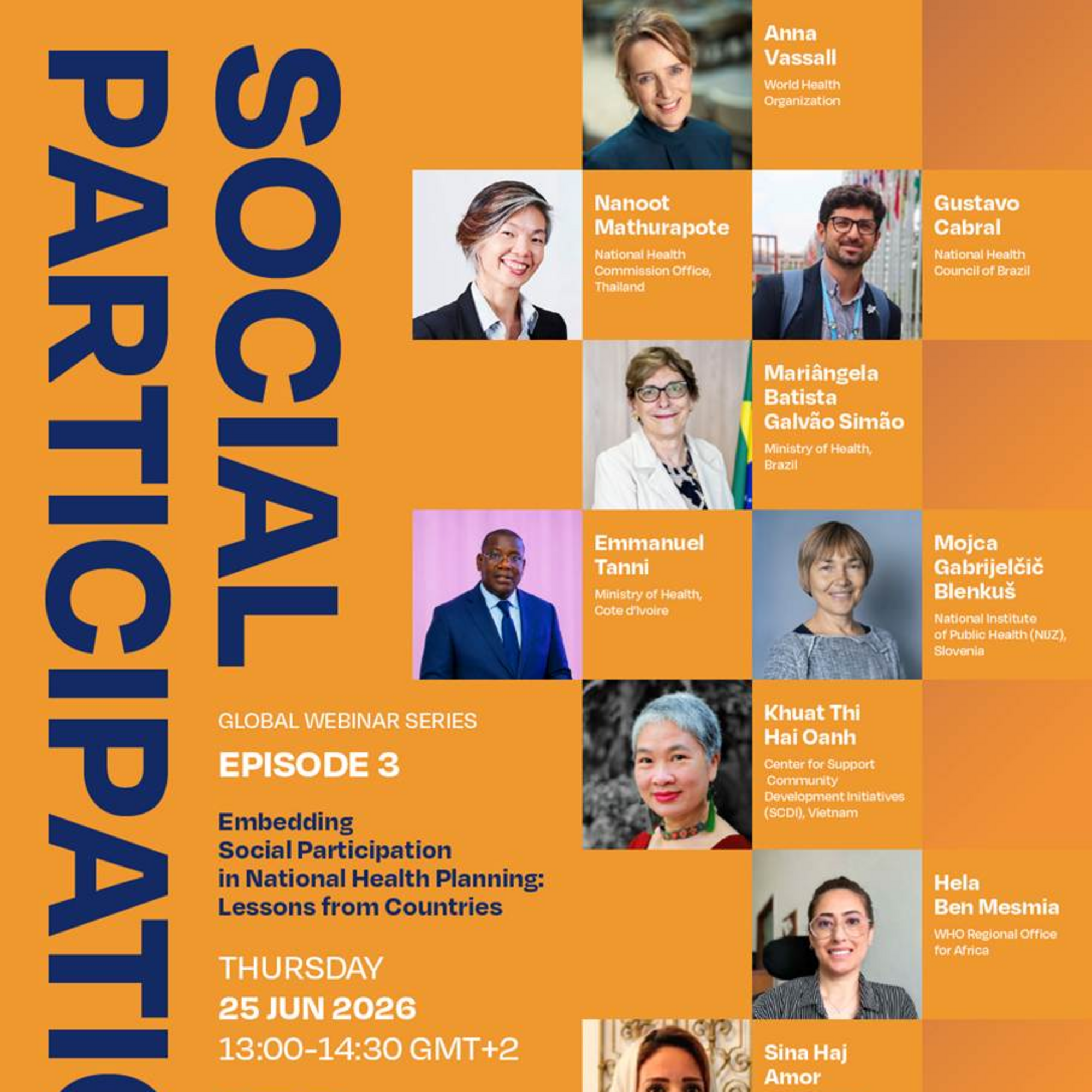
This webinar was the third in a Global Webinar Series on Social Participation in Health, co-hosted by the World Health Organization, Thailand's National Health Commission Office and UHC2030.
Article first published by the Thailand National Health Commission Office
Held on 25 June 2026, the webinar explored how countries are embedding social participation in national health strategic planning processes - not as an add-on, but as a core function of health system governance.
The discussion came at an important moment. Many countries are facing tighter fiscal space, changing population needs and growing pressures on health systems. In this context, decisions about priorities, policy design, resources and implementation need to be informed not only by evidence and data, but also by people's lived realities, needs and values. Participation and evidence should therefore be seen as mutually reinforcing, and both imperative for equity, efficacy and legitimacy in decision-making.
A central message emerged from the opening discussion: social participation is not simply consultation. When institutionalized, it beomes a mechanism for shared ownership and accountability - helping ensure that health systems remain responsive and that governments are answerable for the choices they make.
The webinar featured a deep dive on Brazil's contituionally enshrined and legally protected mechanisms for social participation within the Unified Health System (SUS) - the health councils, which operate in 5570 municipalities and 27 states, and the national health conferences - organized to inform the multi-annual plan and related legislation.
This was followed by a multi-stakeholder panel to reflect on lessons from their contexts, including civil society in Vietnam, Ministry of Health from Tunisia, Slovenia and Cote d'Ivoire, and the WHO African Regional Office.
