
Event summary: 2026 UHC Day Youth Capacity-Building Workshop
27th October 2026
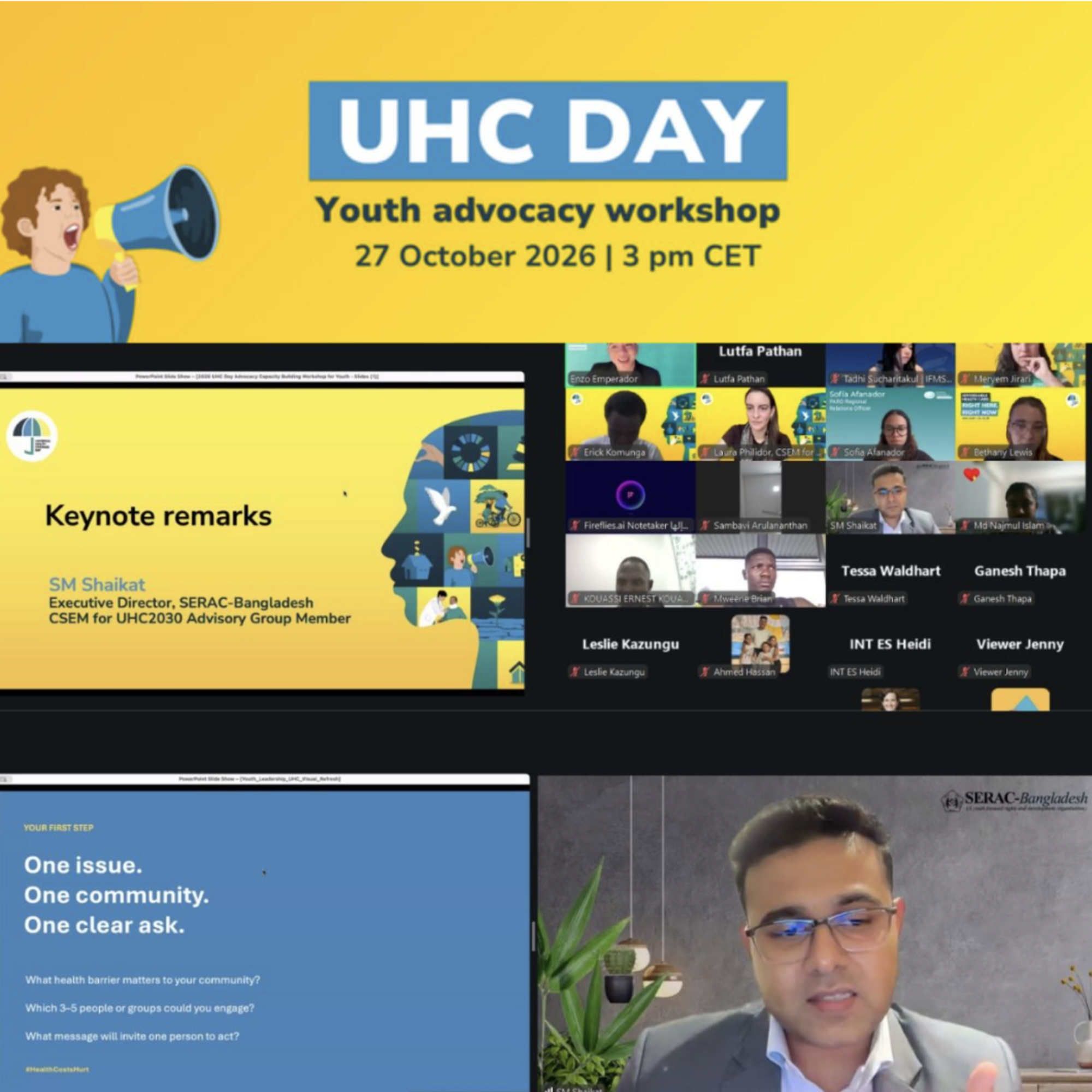
On 27 October 2026, UHC2030, its Civil Society Engagement Mechanism (CSEM) and partners brought together young advocates to explore how to turn the 2026 UHC Day campaign into action in their own communities.
The workshop, titled “Becoming a leader for UHC: Building your local UHC movement”, was co-hosted by UHC2030, its CSEM, the International Federation of Medical Students' Associations (IFMSA), the International Pharmaceutical Students' Federation (IPSF), InciSioN, and the International Alliance of Patients' Organizations (IAPO). Moderated by Enzo Emperador of IPSF, it entailed a keynote on youth leadership, a walkthrough of the UHC Day campaign toolkit, and a practical outreach and mobilization exercise in breakout rooms.
Keynote on youth leadership and community organizing
In his keynote address, SM Shaikat of SERAC Bangladesh and the CSEM Advisory Group described advocacy as beginning with a community experience that feels unfair, such as being unable to afford treatment or being excluded from decisions. Because young people understand many of the barriers their peers face – including a lack of confidential health information, concerns about judgement and the costs of getting services – their leadership is key to help bring these experiences into decision-making.
Shaikat shared SERAC-Bangladesh’s experience of developing a volunteer peer leader model with the Ministry of Health and Family Welfare. Although adolescent-friendly services existed in public facilities, many young people did not know about them or were uncomfortable seeking care. The model initially involved 40 volunteer peer leaders working across 20 government health centres in 4 districts to share information, build trust and connect adolescents with services. Sustained advocacy and evidence sharing had secured government agreement to expand the approach nationally.
Shaikat's account highlighted the importance of working with providers and local authorities, and staying involved as commitments move into implementation, funding and monitoring. He also described the Bangladesh Urban Youth Health Action Network, which grew from a small group into a wider network that helps young advocates learn, organize and raise priorities together. This experience illustrates that networks can start with a few committed people and provide continuity beyond a single campaign or event.
Shaikat concluded his remarks with five practical steps for young advocates:
- Listen to your community. Ask what makes care difficult to access and what would help, reaching beyond familiar networks to include young people with disabilities, those in underserved areas and those who are out of school.
- Choose one issue. Begin with a specific problem people recognize, such as unavailable medicines, transport costs or a lack of confidential information about services.
- Find your people. Connect with peers, youth groups, community organizations and health workers. Identify what each person can contribute and help others recognize their strengths.
- Make a clear ask. Identify who can act – be it a facility manager, local authority or national ministry – and make a practical request linked to their responsibilities.
- Keep following up. Record what was agreed, who is responsible and when an update is expected. Share progress with the community and maintain the conversation when change takes time.
Campaign toolkit walkthrough
Following the keynote address, Bethany Kate Lewis of the UHC2030 Secretariat presented this year's UHC Day campaign as an opportunity for young people to mobilize their communities and influence decision-makers ahead of the 2027 UN high-level meeting on UHC. She explained how to join the Youth Challenge and demonstrated the different components of the UHC Day campaign toolkit. She then announced the launch of Voices for UHC, a new WhatsApp community where advocates from around the world can come together to exchange ideas, share progress and explore collaboration.
Interactive session on outreach and mobilization
Participants then joined five breakout groups: three in English, one in French and one in Spanish. Supported by youth guides, they worked on a practical outreach and mobilization plan they could continue after the workshop. The exercise entailed:
- Identifying a local UHC issue: Using the country profiles in the ACT for UHC Data Dashboard, participants selected an issue relevant to the country or community and considered who is affected.
- Starting an outreach list: Participants then identified the people or groups who might care about the issue, share an experience or help reach others, starting with existing contacts.
- Adapting an outreach message: Finally, each participant chose one contact and prepared messaging to encourage the contact to get involved, such as by sharing a #HealthCostsHurt video or joining a campaign activity.
On returning to plenary, participants were invited to share their chosen issues, intended contacts and proposed actions. Issues highlighted included health insurance for persons with disabilities, access to care in rural areas, language access, gender equality, access to medicines, mental health budgets and affordability.
Closing remarks
Enzo Emperador closed the workshop by inviting everyone to build on the plans started during the session and stay connected through the new Voices for UHC community and its Youth for UHC sub-group.
