
Statement by the UHC2030 Co-Chairs welcoming the adoption of the Political Declaration on NCDs and Mental Health
15th December 2025
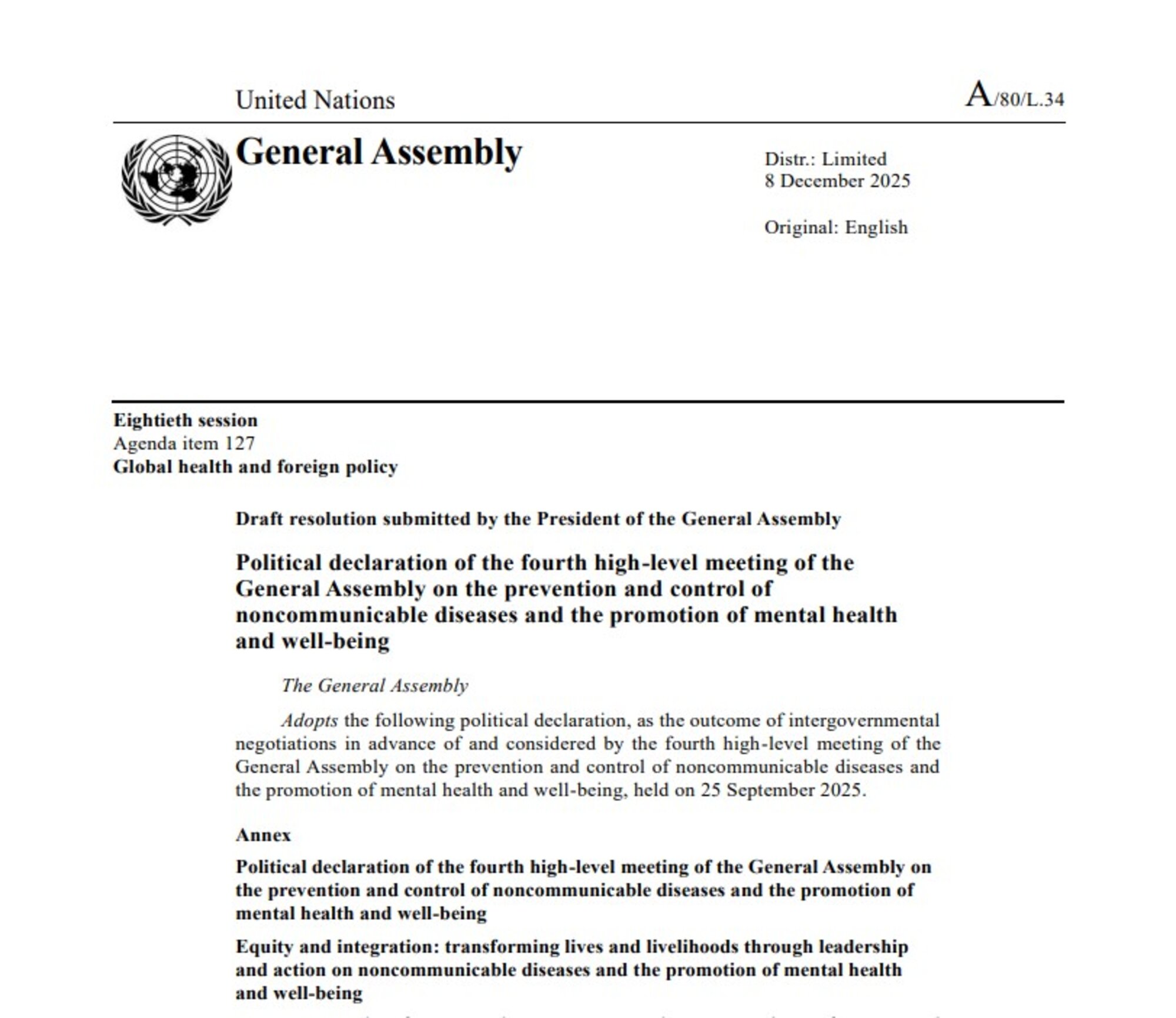
We, the Co-Chairs of UHC2030, welcome the adoption of the Political Declaration on Non-Communicable Diseases (NCDs) and Mental Health by world leaders on 15 December 2025.
The Political Declaration reflects the outcome of the intergovernmental negotiations in advance of and considered by the United Nations High-Level Meeting on the prevention and control of NCDs and the promotion of mental health and well-being, held on 25 September 2025 at the 80th UN General Assembly.
Addressing the urgent challenges posed by NCDs is critical for all, with a disproportionate burden falling on the poorest, most vulnerable, and marginalized populations. This is particularly the case in low- and middle-income countries, where over 60% of people living with cancer and cardiovascular disease spend more than 40% of their income on care, forcing families to make impossible choices, such as seeing a doctor or putting food on the table. When people delay or forgo care due to financial hardship or service inaccessibility, they are denied access to preventive interventions, timely diagnostics, and continuity of care. This is especially detrimental for noncommunicable diseases, as without early detection and sustained management, NCDs often remain undiagnosed until advanced stages, when treatment becomes more complex, less effective, and significantly more costly—both for individuals and for health systems.
The declaration’s adoption today is a clear signal that countries recognize the need to scale up political leadership, investment, and people-centred approaches to deliver integrated health services that leave no one behind. We particularly welcome the emphasis on integrating NCDs and mental health into primary health care, financing strategies that prioritize prevention and early intervention through protection against financial hardship, and involvement of people living with, or at risk of developing NCDs.
As we approach the 2030 deadline for the Sustainable Development Goals, we urge governments to translate these commitments into bold action. For this, they must prioritize implementing national UHC roadmaps and financing plans that are based on clear nationally defined targets that can help drive progress. Most importantly, they need to formalize participatory mechanisms for communities, civil society, youth, and people affected by NCDs and mental health conditions, as a fundamental step to ensure that no one is left or pushed behind.
Implementation is a national responsibility, with each country facing its own reality. What matters is ownership, political will, and drive to turn global commitments into local action, with clear strategies, targets and timelines. The outcome of a high-level meeting alone is not enough to deliver on our commitments to protect and improve rights and access to health services for all, especially girls, women, sexual and gender diverse people and many other groups in vulnerable circumstances. This is why we reiterate our call to ensure countries in their national health strategies focus on:
- Recognizing the centrality of UHC in accelerating progress to address NCDs and mental health conditions, with greater emphasis in primary health care (PHC), and that NCD target 3.4 and UHC target 3.8 are interdependent goals.
- Reducing people’s out-of-pocket expenditures by integrating medicines, diagnostics, health technologies, services and palliative care for NCDs into national health benefit packages aligned with national disease burdens.
- Dismantling disease-specific silos, which lead to inefficiencies and worsening health inequities, and integrate person-centered NCD prevention, care and management into primary health care services.
- Implementing commitments made in the WHA resolution on social participation for universal health coverage, health and well-being, by promoting and institutionalizing the meaningful engagement of communities, including people living with, or at risk of, NCDs and mental health conditions as a core mechanism for delivering on the HLM Political Declaration on NCDs and mental health.
- Investing in the workforce needed to meet the demands of care that will increase PHC, and address prevention, treatment, and management of NCDs.
- Urging governments to maintain a future focus by implementing additional strategies to boost domestic funding, such as raising revenue through taxing of health harming products which has been proven successful in a number of countries.
We all know there is no path to effectively address NCDs without universal health coverage. With NCDs causing 41 million deaths and 75% of global mortality and costing over $2 trillion annually, timely access to affordable health services is an imperative.
UHC2030 stands ready to support countries in turning this commitment into results—building resilient, equitable health systems that deliver for all, particularly those living with or at risk of NCDs and mental health conditions.
Let this declaration be a turning point. Health is a human right and must become a reality for everyone everywhere. Let us act decisively, inclusively, and urgently.
