From commitment to action: why 2027 must mark the turning point for universal health coverage
25 Mar 2026

The next UN High-level meeting (UN HLM) on universal health coverage (UHC) will take place in September 2027. It will be an opportunity for countries and stakeholders to review progress on commitments made in the 2023 Political Declaration for UHC.
At the 2023 UN High-level meeting on UHC, Member States unanimously recognized that universal health coverage (UHC) is fundamental to achieving all of the Sustainable Development Goals (SDGs) – not only those related to health and well-being (SDG 3), but also those related to poverty eradication, access to education, gender equality, climate change and building peaceful and inclusive societies. The upcoming high-level meeting in 2027 will be an opportunity to take stock on progress made towards implementing the 2023 Political Declaration to realize the fundamental right to health for everyone, everywhere.
The 2027 high-level meeting is our golden opportunity to ensure that health for all remains a defining principle of global development, not a forgotten aspiration.
The 2027 UN high-level meeting on universal health coverage is a pivotal moment. We need strategic actions, backed by financing and accountability, to build resilient, people-centred health systems that truly leave no one behind.
On 25 March 2026, the co-chairs of the UHC2030 Steering Committee published an article in the Lancet emphasizing the need for a fundamental transformation of health systems to make them equitable and resilient and outlining key steps to ensure that the 2027 UN HLM on UHC produces an ambitious, action-oriented Political Declaration with measurable targets, investment commitments, and accountability mechanisms.
The 2023 Political Declaration on UHC reaffirmed the international community’s commitment to achieving UHC by 2030, but significant gaps remain in implementation. Many health systems continue to face structural challenges, including workforce shortages, inadequate financing, and unequal access to services. Financial hardship caused by health expenses also remains a major barrier to care for millions of people worldwide.
The next two years represent a critical advocacy window during which civil society, governments and international organizations must work together to ensure the 2027 Political Declaration is action-oriented, with measurable targets, transparent accountability mechanisms, and sustainable financing.
This entails mobilizing stakeholders to maintain momentum generated by global initiatives and campaigns such as UHC Day, encouraging governments to assess national progress toward UHC targets, and strengthening advocacy efforts aimed at policymakers and parliamentarians.
On 4 March 2026, UHC2030 and the Civil Society Engagement Mechanism (CSEM) for UHC2030 convened global health advocates, civil society organizations, youth representatives and policy stakeholders to reflect on the outcomes and advocacy impact of the 2025 UHC Day campaign and to discuss how to sustain momentum in the lead-up to the 2027 UN HLM on Universal Health Coverage.
In the lead up to the 2027 HLM on UHC, advocates must actively engage with governments using clear, evidence-based insights on national health system performance, identifying both progress and remaining gaps. Decision-makers must also support coordinated advocacy efforts across regions, ensuring that civil society voices remain central to the global UHC agenda.
UHC2030’s Global UHC Action Tracker (ACT for UHC) allows advocates and decision-makers to highlight achievements and identify gaps in implementing UHC commitments, and drive evidence-based decision-making. It also serves as a powerful advocacy tool to call for more and better action to make health for all a reality. It is designed to complement other UHC monitoring efforts, such as the World Health Organization (WHO) and World Bank Group report, Tracking Universal Health Coverage: Global Monitoring Report (GMR).
ACT for UHC includes two components – a synthesis report and data dashboard – to bring a unique multi-stakeholder view to a simple question: Are countries acting on their commitments to UHC?
The ACT for UHC report draws on statistical indicators, policy document analyses and UHC2030’s global survey to assess progress towards UHC and identify gaps and vulnerabilities.
The ACT for UHC dashboard provides comprehensive data sets, including country-level information, to track the implementation of key commitments adopted in the 2023 Political Declaration on UHC.
Universal health coverage is not only a health goal but also a fundamental pillar of social justice and human development. Yet despite strong political commitment in most countries, impact is uneven. Progress on health financing – along with reductions in out-of-pocket spending and financial hardship – remains modest, and there are still large disparities between high- and low-income countries in terms of health spending per capita.
Stark differences also remain in service coverage, health benefit packages, health workforce density and digital health strategies, and significant inequalities persist within countries, particularly between richer and poorer households and between individuals living in urban or rural areas. Progress on gender equality in health has also been limited. These gaps, combined with slow advances in inclusive and participatory governance, continue to undermine the goal of leaving no one behind.
Recognizing that there is no single pathway to UHC, UHC2030 will work with its dedicated Task Force to develop a set of advocacy priorities and a narrative to ensure that the global movement for UHC is speaking in a unified voice.
The 2027 UN HLM Task Force will oversee the development of advocacy priorities and a narrative from the UHC Movement based on the latest data, the new global health context, and inputs received through inclusive consultations.
The Task Force will aim to submit a limited number of action-oriented policy recommendations to the President of the UN General Assembly ahead of the 2027 UHC Political Declaration negotiations. It will also be instrumental in providing political advocacy and strategic communications support to UHC2030 throughout the preparation for the 2027 UN HLM on UHC.
Members of the 2027 HLM Task Force represent the following groups and networks (in alphabetical order):
Similar to the Action Agenda from the UHC Movement published for the 2023 UHC HLM, this new narrative will provide a set of coherent and consistent messaging for stakeholders to engage in the 2027 HLM process.
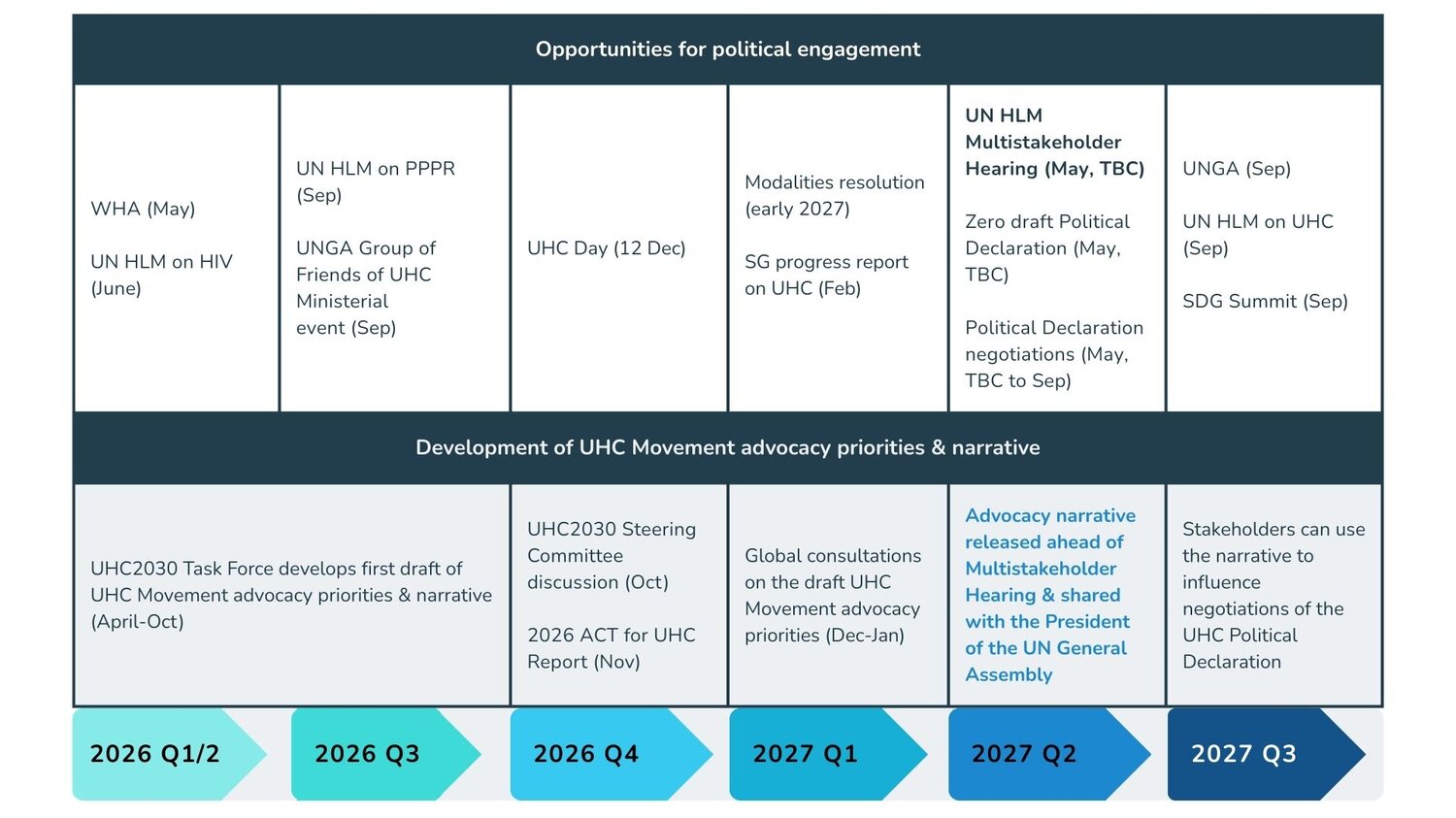
To develop this narrative, UHC2030 will host a series of global consultations between late 2026 and early 2027, with the goal of releasing it before the multi-stakeholder hearing on UHC, which should take place by mid-2027. We will also share it with the President of the UN General Assembly as a contribution to the zero draft political declaration on UHC.
Refer to the image below for a detailed timeline of the process and advocacy opportunities along the way.
Sign up for our newsletter for updates on the process and opportunities engage, and keep coming back to this page for the latest resources and messaging.